Art Nouveau route in the Mugello area
An unsusual but fascinating aspect of the Mugello area and in particular of his most important town, Borgo San Lorenzo, is being a reference point for the Art Nouveau period in Italy.
Chini Manufacturing , a great example of arts and crafts in the production of ceramics was born right here in the early 19th century with the head of the family Piero Alessio Chini, but became especially famous with his sons and nephews, who turned from apprentices to versatile and creative artists.
Galileo Chini was the figurehead who, together with his cousin Chino, founded in 1906 the Fornaci San Lorenzo manufacturing in Borgo San Lorenzo, producing highly successful ceramics and glass works.
In the early 20th century Galileo Chini was one of the main exponents of Italian Art Nouveau, so well known that in 1906 he was summoned to Bangkok to fresco the Throne Hall.
One of the most famous works of the Manufacturing is the covering of the Lorenzo Berzieri thermal bath in Salsomaggiore where Galileo Chini, assisted by various artists of the time, frescoed some sections of the walls.
World War II bombings badly damaged the Borgo San Lorenzo Manufacturing, and due to this it didn't manage to recover its strength; but the works produced in the building are still there to prove their skill and uniqueness.
In the Mugello area you can follow art-nouveau-themed itineraries, carefully looking for the traces of the leading figures of this creative family.
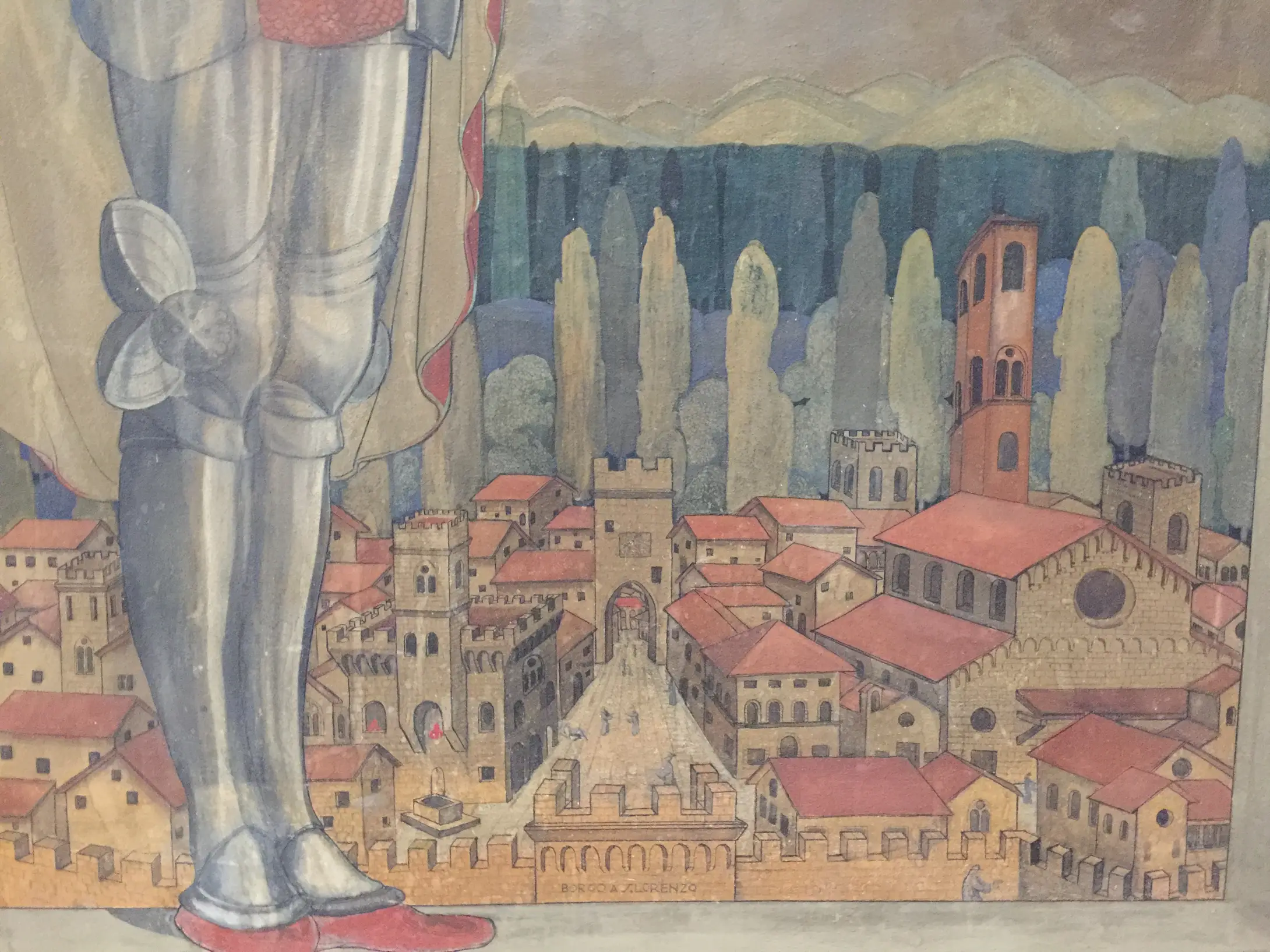
The first leg of this route is undoubtedly the Chini Manufacturing Museum in the Villa Pecori Giraldi. The rooms are frescoed by the Chini family members, from Pietro Alessio to Galileo, with geometrical and floral patterns and mock-medieval paintings. A beautiful spiral staircase leads to the upper floor; an important decorative cycle portraying Saint George is found in the reception hall. Quite impressive is the display of ceramic pieces, stoneware objects and vases and rare polychrome glass windows.
The route continues with the San Lorenzo Parish church, featuring the apse with the blessing Christ between Saints Lawrence and Martin, a mural painting in which Galileo Chini wished to celebrate his flexible and diverse art. The decorative patterns and the vivid traits with which the characters are outlined are typical of the Italian decorative art of the first half of the 20th century.
Next to the Parish church is the Tabernacle of Saint Francis that was entirely made by the Chini family in 1926, for the hundredth anniversary of the Saint's death.
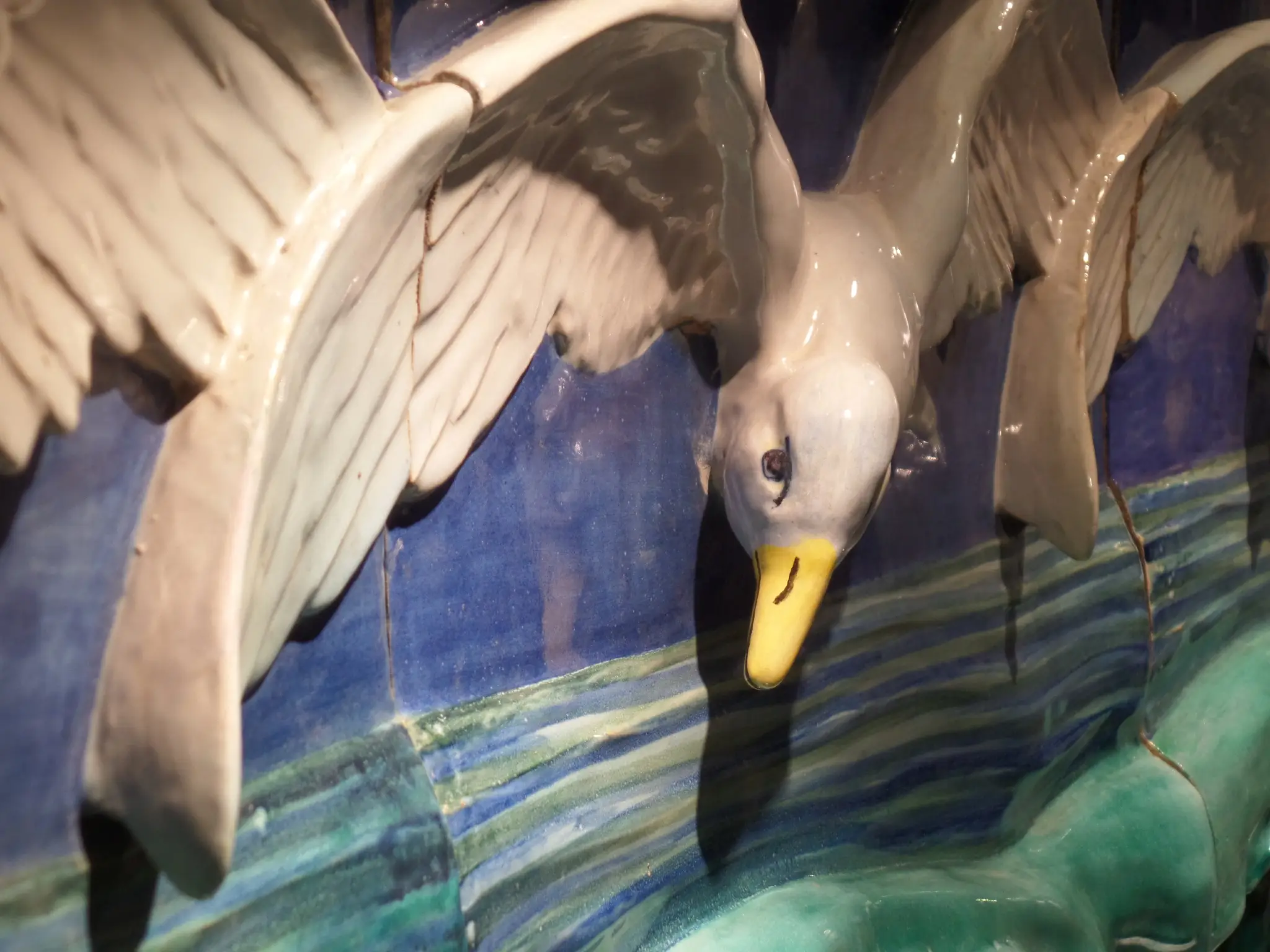
The recess, located in a wall of the Saint Catherine monastery, houses a ceramic statue of Saint Francis and is lined with tiles. The wall is decorated with paintings portraying a lamb and a wolf while particular attention is put on the tiles depicting the coats of arms of the most important families of the Mugello area. The whole complex is covered by a tile-lined canopy, from which hangs a wrought iron lamp.
Another interesting work of the Chini brothers in a palace, this time the BorgoSan Lorenzo town hall, is on the first floor in the fully decorated Mayor's office. Especially beautiful is the floor adorned with a radial pattern and the strictly Art Nouveau windows.
The devastation left by the destructive earthquake in 1919, saw the Chini manufacturing engaged in important endeavours: new buildings were constructed, other ones were decorated.
Among the ones worth seeing is the whole Villino Chini complex, where a descendant of the family still lives, in all its sumptuous decor; or the cottages on Viale dellaRepubblica, dating back to the early years of the century and particularly noteworthy for their decorations and the urban layout.
The detailed route is available on the Unione Montana dei Comuni del Mugello website
Foto Archivio Unione Montana Comuni del Mugello
Etappen
Chini Museum
The refurbished museum, inside the Villa Pecori Giraldi, condenses the fruit of the Chini family's multifaceted activity, which began in Borgo San Lorenzo in 1906, ranging from architectural complements to ceramic and stoneware furnishing objects to stained glass windows. Inside the Chini Museum, visitors will find a permanent collection dedicated to the works and history of Galileo Chini and family and temporary exhibitions exploring the contemporary.
Inside the Museum is the Children's Museum: seven rooms, also designed using company waste materials, in which children are free to express their talents, taking inspiration from 20th century artists and contributing, with their own creations, to build an exhibition of creative ‘traces’. The Children's Museum is temporarily closed.
Chini Museum will be closed for renovation from November 3, 2025 until summer 2026.
Pieve di San Lorenzo
Situata proprio nel centro storico di Borgo San Lorenzo, questa pieve risalente al 941 è il più grande fra gli edifici romanici nel contado fiorentino.
La torre campanaria risale probabilmente all'epoca della ricostruzione del 1263; edificata in mattoni, si erge sopra l'abside semicircolare e ha una particolare forma in semidodecagono.
All'interno, l'abside è stata affrescata da Galileo Chini, eminente esponente del Liberty in Italia. Inoltre, la ricchezza delle opere conservate nella chiesa è una testimonianza dell'importanza che aveva in passato questa pieve; vi sono infatti conservati una Madonna attribuita a Giotto (pittore mugellano, era nato a Vicchio), un crocifisso di scuola giottesca, una Madonna in Trono attribuita ad Agnolo Gaddi, una Vergine e Santi di Matteo Rosselli.

Municipio di Borgo San Lorenzo
Il figlio di Chino Chini, Tito (1898-1947), negli anni Trenta del '900, diresse i lavori di realizzazione del Municipio di Borgo San Lorenzo, occupandosi della decorazione murale, delle vetrate, del grande lucernario e delle finestre, del bel pavimento in ceramica con motivi a raggiera nella stanza del sindaco e di gran parte delle suppellettili lignee che decorano gli interni.