Florence of Women: Works by Extraordinary Female Artists
An itinerary through the works of female artists who enriched Florence with their art, and the contribution of data collected by AWA – Advancing Women Artists.
Admirable Female Artists in Florence
1. Artemisia Gentileschi (Rome 1593 – Naples 1652/53)
An Italian painter of the Caravaggio school, she lived in Florence for a brief period and was the first female painter to be admitted to the prestigious Accademia del Disegno in Florence, gaining recognition as an artist from the Medici Court.
This was a true feat for an era in which artistic production was almost exclusively the prerogative of men. Artemisia, in fact, trained in the workshop of her father, Orazio (a friend of Caravaggio), alongside her six brothers. A victim of kidnapping and rape by the painter and mentor Agostino Tassi, her talent and her desire to speak out can be admired throughout her works.
2. Plautilla Nelli (Florence, 1524 – Florence, 1588)
Plautilla entered the former convent of Santa Caterina da Siena in Piazza San Marco, Florence, at the age of 14. A nun and Renaissance painter—the first to be recognized as such—she became prioress of the convent three times, forging relationships with influential families and using her position to establish a very active art workshop. To date, 17 paintings are attributed to Plautilla.
3. Giovanna Garzoni (Ascoli Piceno, 1600 – Rome, 1670)
A painter and miniaturist, she lived and worked in many Italian cities, including Florence (1642–1651), where she executed several works for the Medici Grand Dukes, particularly Ferdinando II de’ Medici and Vittoria della Rovere. Many of her works—including a series of splendid still lifes, a subject in which she was a true specialist—are preserved within the Uffizi Galleries and the Palatine Gallery.
4. Violante Beatrice Siriès (Florence, 1709 – Florence, 1783)
A true Florentine, daughter of the French goldsmith and gem engraver Louis Siries (who was also director of the Opificio delle Pietre Dure in Florence), Violante was a portraitist of the 18th-century Tuscan nobility. In 1732, after the death of Giovanna Fratellini, she took her place as the official portraitist of the Medici Court.
5. Elisabeth Chaplin (Fontainebleau, 1890 – Florence, 1982)
Born into an artistic family, Elisabeth is the female painter with the most works preserved in Florence. Arriving in Tuscany as a child, she began as a self-taught artist by admiring the classical works in the Uffizi. Her art led her to the atelier of Francesco Gioli and to meet Giovanni Fattori. After living and maturing her experience between Rome and Paris, she settled permanently in Fiesole at the end of the war.
Where to Find the Works
Uffizi Gallery
- "Judith Slaying Holofernes", A. Gentileschi
- "Still Life with a Plate of Cherries", G. Garzoni
- Three self-portraits by Violante Siriès Cerroti
- Works by Rosalba Carriera
2. Pitti Palace
- "St. Mary Magdalene", A. Gentileschi (Palatine Gallery)
- "Little Dog with a Biscuit and Chinese Cup", G. Garzoni (Palatine Gallery)
- "Rest on the Flight into Egypt (Oasis)", "The Three Sisters", E. Chaplin (Gallery of Modern Art)
3. Other Locations
- "Allegory of Inclination", A. Gentileschi, at the Casa Buonarroti Museum.
- "Lamentation over the Dead Christ", P. Nelli, at the San Marco Museum.
- "Saint Dominic Receiving the Rosary" and "Saint Catherine in Prayer", P. Nelli, at the Museum of the Cenacolo di Andrea del Sarto.
- "The Last Supper", P. Nelli, at the Santa Maria Novella Museum.
- "Representation of Saint Maria Maddalena de' Pazzi", V. Siriès, in the sacristy of the Church of Santa Maria Maddalena dei Pazzi.
- "Saint Francis of Assisi", V. Siriès, in the Capuchin Museum of Florence.
AWA – Advancing Women Artists
For everything else, visit the AWA website. AWA is an American non-profit organization committed to identifying, restoring, and exhibiting artworks by women from Florentine storehouses. They are credited with many restorations; unfortunately, AWA has not been operational since July 2021, though they have left their entire digital archive and website accessible.
The places
Stages
Uffizi Gallery
With its immense artistic legacy, the Uffizi Gallery, now The Uffizi, is one of the most important museums in the world. Following a substantial reorganization in the 17th century, which led to the transfer of some collections (arms, scientific instruments, archaeological finds, ancient and modern bronzes) to other sites and the establishment of new museums, the Uffizi mainly became a picture gallery, with thousands of works ranging from the 13th to the 18th centuries. After the suppression of churches and convents in the 18th and 19th centuries, many works of ecclesiastical provenance swelled the gallery’s collections; other important paintings were acquired at the beginning of the 20th century.
Masterpieces held in the museum include: the large altarpieces of Cimabue and Giotto; 14th-century Sienese art (including a fine Annunciation by Simone Martini); a rich spectrum of 15th-century art from Tuscany and central Italy, with works by Masaccio and Masolino (Madonna and Child with Saint Anne), Filippo Lippi, Botticelli (Birth of Venus and the Primavera), Piero della Francesca (Portraits of Duke Federico da Montefeltro and his Duchess Battista Sforza of Urbino) and Gentile da Fabriano (Adoration of the Magi).
The rooms devoted to 16th-century painting contain works by the masters of the principal Italian schools: from the Adoration of the Magi by Leonardo da Vinci to Michelangelo and Raphael, while Titian, with his Venus of Urbino, Veronese and Tintoretto represent the flowering of painting in the Veneto. Foreign artists are also well represented, with works by Albrecht Dürer, Hans Holbein and El Greco.
The series of 17th-century works opens with Caravaggio’s Bacchus, and features a rich range of work from the major European schools, including Rubens, Van Dyck and the self-portraits by Rembrandt. Finally, Canaletto and Guardi, together with Longhi and Tiepolo, offer a sample of 18th-century art. In addition, the gallery holds ancient sculptures, miniatures and tapestries from the Medici collections. Work is currently underway on the ‘New Uffizi’, which will double the amount of exhibition space, permitting the display of works previously inaccessible to the public.
A map of suggested paths in the gallery - including their duration - is available on the Uffizi Official Website.

Palatine Gallery and Royal Apartments - Pitti Palace
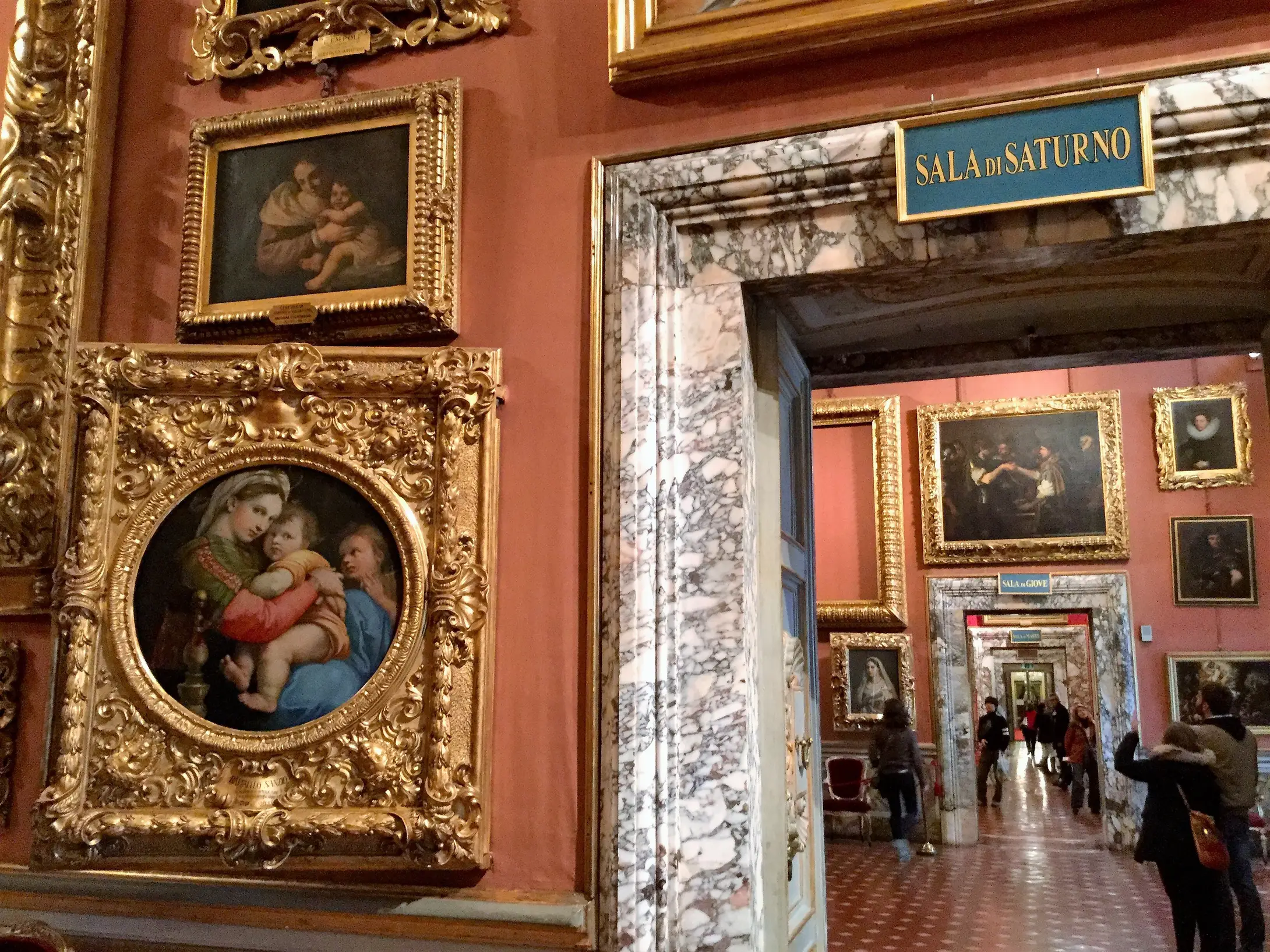
The Palatine Gallery and the Royal Apartments occupy the whole of Palazzo Pitti’s piano nobile. The gallery was established in the late 18th and early 19th centuries by the Lorraine, who hung a mass of artworks, principally from the Medici collections begun around 1620, in the reception rooms. There are works by Raphael, Titian, Caravaggio, Rubens, Pietro da Cortona and other Renaissance and 17th-century artists from Italy and elsewhere in Europe.
The walls of the rooms are plastered with paintings, in keeping with the tradition of 17th-century picture galleries: they are not arranged chronologically or by school, but reflect the personal taste of the collectors. There is a fine Madonna and Child by Filippo Lippi, some of Raphael’s most famous paintings, including the so-called Madonna del Granduca and La Velata, a Young Saint John the Baptist by Andrea del Sarto, Titian’s La Bella and portraits by Veronese and Tintoretto.
The Royal Apartments consist of fourteen rooms in the right wing of the palace, formerly the private residence of the ruling families, and are furnished with furniture, trappings and artworks ranging from the 16th to 19th centuries.
Modern Art Gallery - Pitti Palace
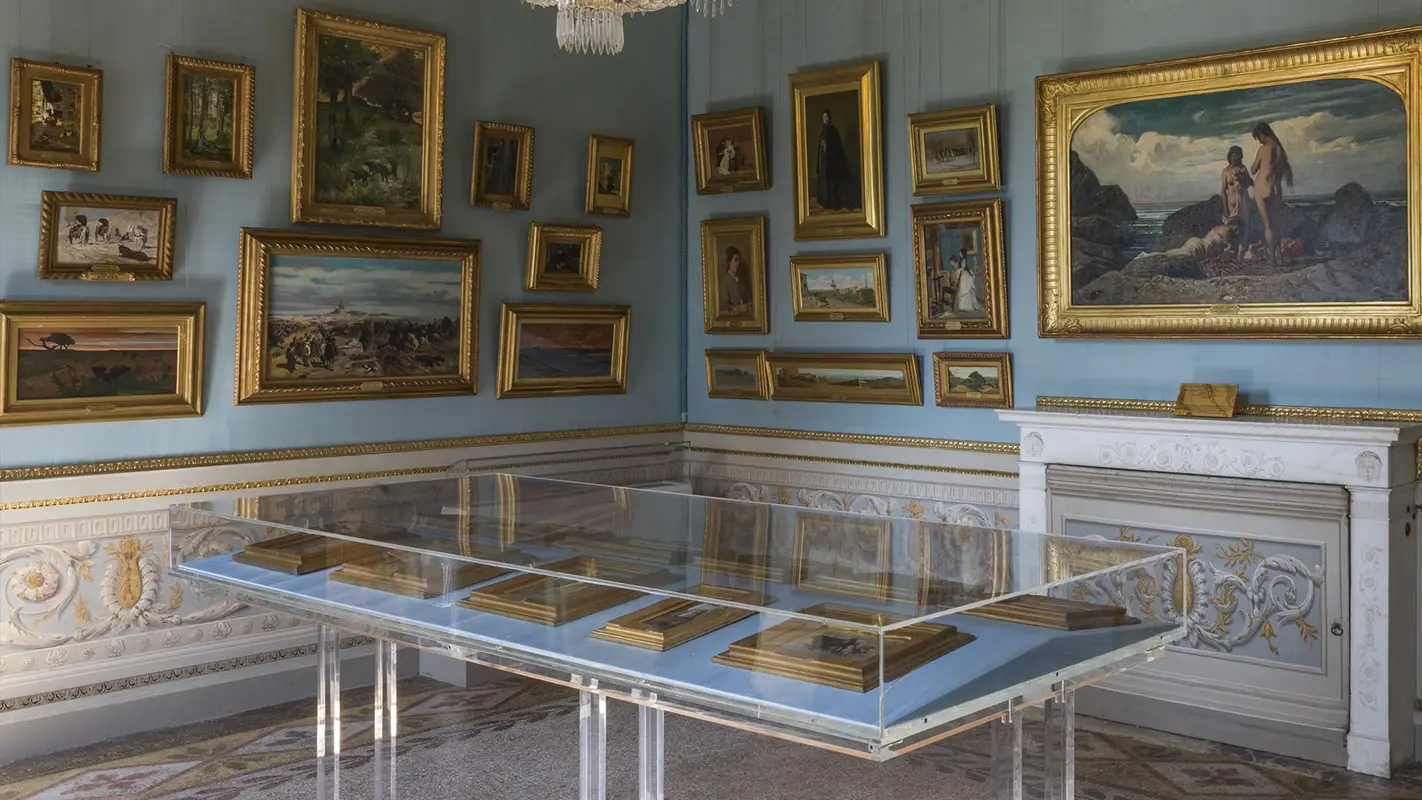
The Galleria d'Arte Moderna is located on the second floor of the Pitti Palace, and is a museum where one can admire collections of sculptures and paintings spanning the period between the late 18th century and the early decades of the 20th century, displayed in elegantly decorated and furnished monumental rooms.
The works bear witness to important artistic currents such as Neoclassicism, Romanticism, but above all the Macchiaioli School, which in the mid 19th century constituted a break with academic painting in Tuscany. Giovanni Fattori, one of the most significant Macchiaioli painters, can be admired in this museum.
The thirty rooms also house evidence of the Italian schools of the second half of the 19th century, with currents linked to Decadentism, Symbolism, Post-Impressionism and Divisionism, up to the artistic movements of the early 20th century.
The Andito degli Angiolini, often used for temporary exhibitions, is also part of the museum itinerary.
Fondazione Casa Buonarroti
The Museo di Casa Buonarroti is to all intents and purposes the temple of Michelangelo's memory.
Acquired by Michelangelo Buonarroti himself around 1510, the property only became central to the Buonarroti family in the 17th century, when the palace took on its current appearance. It was in fact thanks to his great-grandson Michelangelo the Younger, a prominent figure in 17th-century Florentine culture, that this house was decorated with paintings celebrating the family glory, to which four rooms were dedicated.
The core of the collection are Michelangelo's autograph works: exraordinary early sculptures such as the Madonna of the Staircase, the Battle of the Centaurs; the display includes Etruscan and Roman sculptures, Renaissance and 17th-century paintings, Della Robbia glazed terracotta. The great Master is also responsible for the large wooden model for the façade of San Lorenzo Church and the River God, a sketch for the New Sacristy (Medici Chapel Complex).
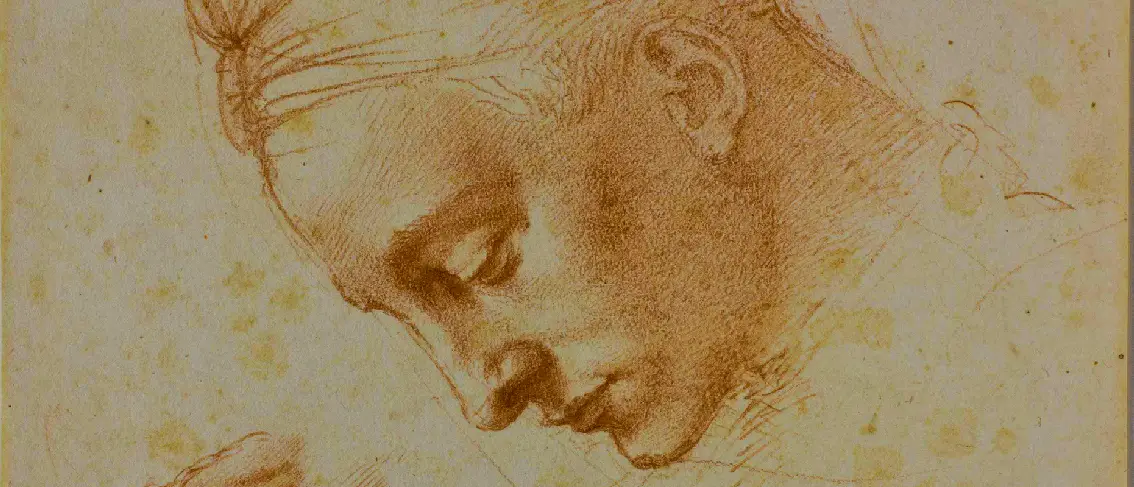
Thanks to the curatorship of the Fondazione Casa Buonarroti, the museum has an intense exhibition activity, and groups of Michelangelo's drawings are also temporarily exhibited in rotation.
Museo di San Marco
The St. Mark's Museum, commonly known as the ‘Beato Angelico's museum’, occupies the spaces of the former Dominican convent that Michelozzo rebuilt in Renaissance style on the commission of Cosimo il Vecchio de' Medici. The charm of this museum is mainly due to the convent's rooms, marked by the works of Beato Angelico, the friar-painter who lived and worked here in the first half of the 15th century.
Numerous panel paintings by Beato Angelico are exhibited in the room dedicated to him on the ground floor. Around the cloister are the rooms in which community life took place: the Hall of the Blessed, the Chapter House (splendid fresco of the Crucifixion). The upper floor, in the corridor and cells, is embellished with an extraordinary cycle of frescoes by Angelico (Annunciation and Stories from the Life of Jesus); in one of these lived the famous preacher Frà Girolamo Savonarola. Also on the first floor is the Monumental Library, a work by Michelozzo in pure Renaissance style.
Returning to the ground floor, one can admire the two refectories (frescoes by Domenico Ghirlandaio and Sogliani), as well as a topographical section with some architectural fragments from the area of Piazza della Repubblica, at the time of the 19th-century redevelopment of Florence as the capital city of Italy (1865-1871).
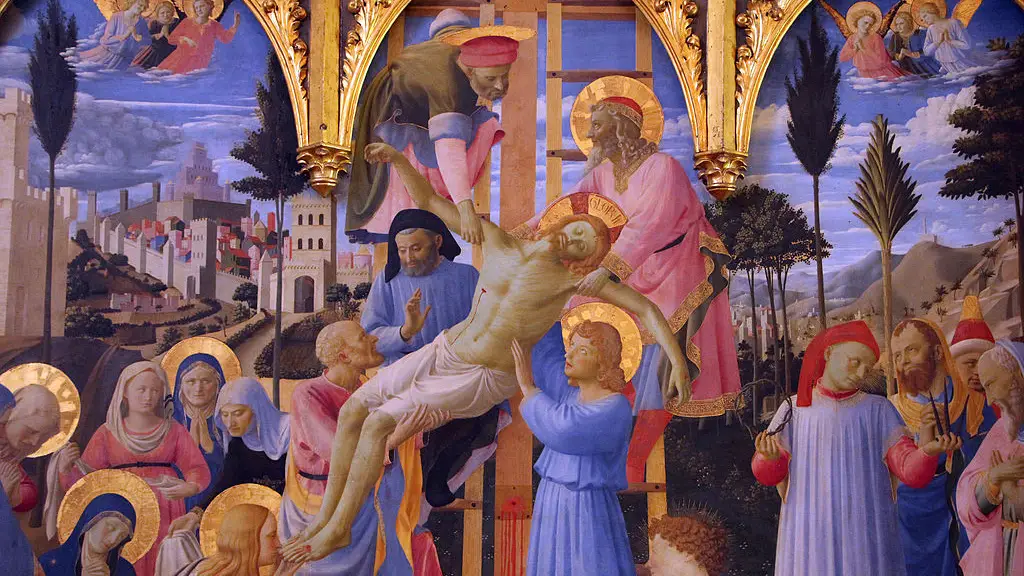
Cenacolo and Museum of Andrea del Sarto - San Salvi
The Last Supper and Museum of Andrea del Sarto at San Salvi occupies the 16th-century rooms of the ancient Vallombrosian monastery of San Salvi and is named after the splendid Last Supper frescoed by Andrea del Sarto (1551-1526).
Accompanying this masterpiece, partly inspired by Leonardo da Vinci's Last Supper in Milan, are a series of large altarpieces by 16th-century Tuscan painters, contemporaries of Andrea del Sarto, the ‘painter without errors’; these also include early works by Pontormo, his pupil, and the remarkable funeral monument to St. John Gualbert (founder of the Vallombrosan Order of Monks) by Benedetto da Rovezzano.
The Last Supper by Andrea del Sarto is part of the itinerary of the Florentine Cenacles.

Museum and Monumental Cloisters of Santa Maria Novella
The Santa Maria Novella Complex includes a series of striking rooms, adjacent to the Basilica, decorated from the 14th century onwards.
Of great impact is the Green Cloister, entirely frescoed by Paolo Uccello (c. 1425) with scenes from the Old Testament, including the episodes of the Universal Flood and Noah's Drunkenness, manifestos of the early Florentine Renaissance. The grandiose Cappellone degli Spagnoli - formerly the Dominican chapter house and then place of worship of the Spanish community following Eleonora di Toledo, wife of the Medici Grand Duke Cosimo I - is entirely decorated with astonishing 14th-century frescoes by Andrea di Bonaiuto; the Chiostro Grande (the largest cloister in the entire city) was frescoed in the second half of the 16th century by a series of Florentine artists (Bernardino Poccetti, Alessandro Allori and others). These two pictorial cycles depict stories of the Dominican Order and episodes from the life of Christ. Next to the Chiostrino dei morti, the ancient cemetery of the complex, is the Cappella degli Strozzi, frescoed by Andrea Orcagna (around 1350).
The Cappella degli Ubriachi and the Refectory (where the original lunettes of the green cloister by Paolo Uccello are preserved) house a collection of sacred art with precious textiles, embroidery, wooden sculptures and goldsmithery.
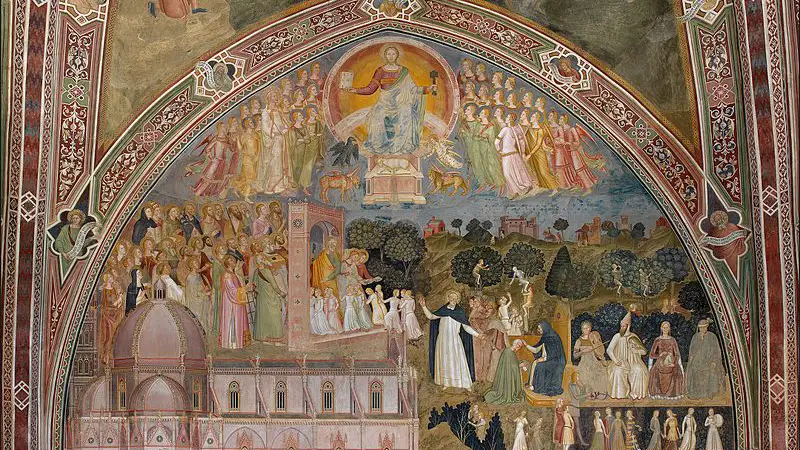
Chiesa di Santa Maria Maddalena de' Pazzi
The foundation dates back to 1257, dedicated to Santa Maria Maddalena delle Convertite, in the place where there was already a home for women with bad reputation who followed the rule of San Benedetto; later on the structure passed to the Cistercians of Badia a Settimo, who settled there only in 1442. In 1629 the Cistercian monks literally exchanged ownership with the Carmelites of San Frediano in Cestello. The nuns also brought with them the mortal remains of the sister Maria Maddalena de 'Pazzi who in 1669 was beatified and thus gave the church its name.
Inside you can admire works by Carlo Portelli, Alfonso Boschi, Domenico Puligo. Of particular interest are the martyrdom of Saints Nereo and Achilleo by Domenico Passignano and the large altarpiece by Cosimo Rosselli depicting the Coronation of the Virgin. In the Chapter Room there is the famous Crucifixion by Perugino.

Chiesa di San Francesco e Santa Chiara a Montughi
Parish church adjacent to the convent of the Capuchin friars of the Province of Tuscany.
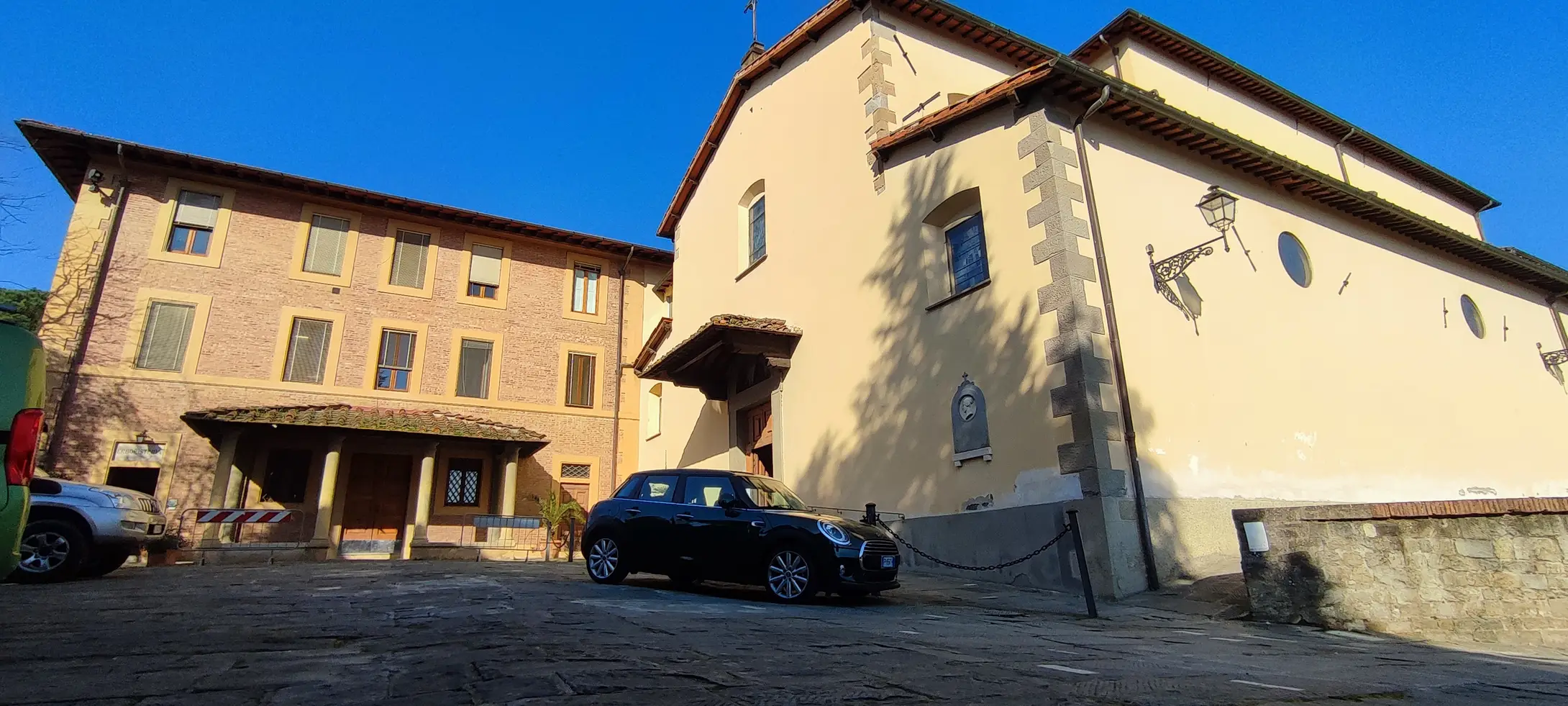
The convent church, which was consecrated on October 15, 1623, is dedicated to St. Francis of Assisi. After successive enlargements, it owes its current form to the work carried out in 1955-56.
The convent, which originally developed around the single main cloister, still known today as “Bianca Cappello” (named after the woman who financed its construction), has undergone numerous and significant transformations and extensions over the centuries, due to the ever-increasing number of friars who lived there, until it reached its current form, which includes three cloisters.
The convent has an apothecary with a shop, a library, and houses numerous works of art.