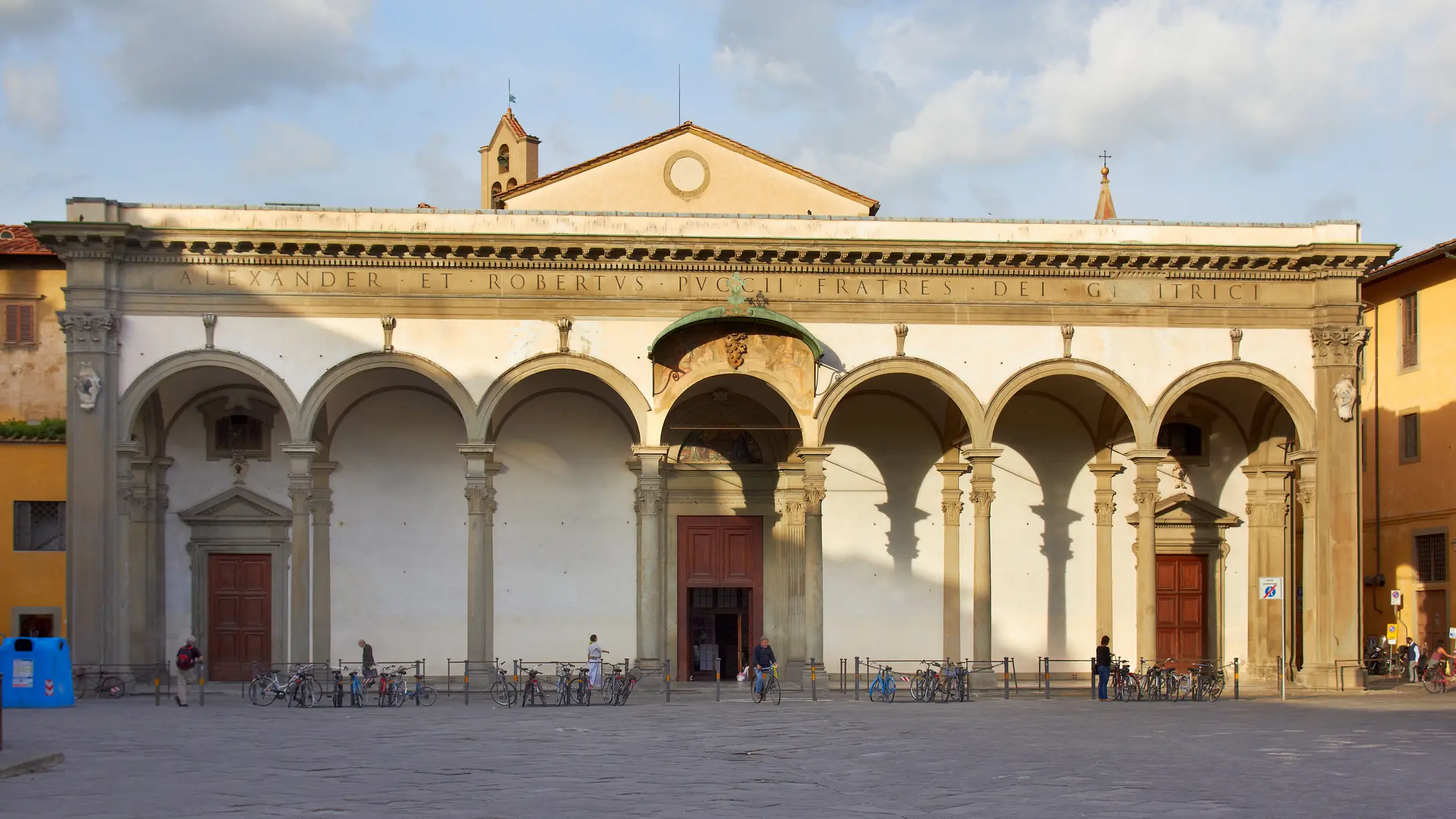
Do you know Andrea del Castagno?
Andrea di Bartolo di Bargilla (the real name of the artist Andrea del Castagno) was one of the leading painters of the Florentine Renaissance
He was born in 1423 in a village in the Apennines on the slopes of Mount Falterona, called Castagno, which in 1957 took the artist’s name in his honour, becoming Castagno d’Andrea.
During the wars between Florence and Milan, Andrea and his family took refuge in Corella, at the Belforte fortress in the municipality of Dicomano, and only returned to Castagno once the conflict had ended. In 1440, he was taken to Florence and apprenticed to an unnamed painter; he worked as an artist in Florence and Venice; he died of the plague and was buried in the Basilica of Santissima Annunziata in Florence in 1457.
During his formative years, he was greatly influenced by Masaccio and Donatello; his works are characterised by sombre, ‘earthy’ colours and particularly realistic figures. Many of his frescoes are in Florence, including those in the Convent of Sant'Apollonia, the Basilica of Santissima Annunziata and the Uffizi Gallery. He also created the cycle of frescoes depicting nine illustrious men and women, which was intended to adorn Villa Carducci in Legnaia. Those frescoes are now in the Uffizi.
In the Cathedral of Santa Maria del Fiore, he painted the fresco depicting Niccolò da Tolentino.
Andrea’s greatest work is undoubtedly the cycle of frescoes depicting the Passion, painted between 1445 and 1450 in the Refectory of Sant’Apollonia, depicting the Last Supper, the Crucifixion, the Descent from the Cross and the Resurrection.
His paintings, on the other hand, are housed in museums all over the world.
In his native village, he is commemorated in a house (which is certainly not the original, as the village was destroyed during the Second World War) and through a virtual museum, which displays reproductions of his works.
Comune di Firenze
The places
Stages
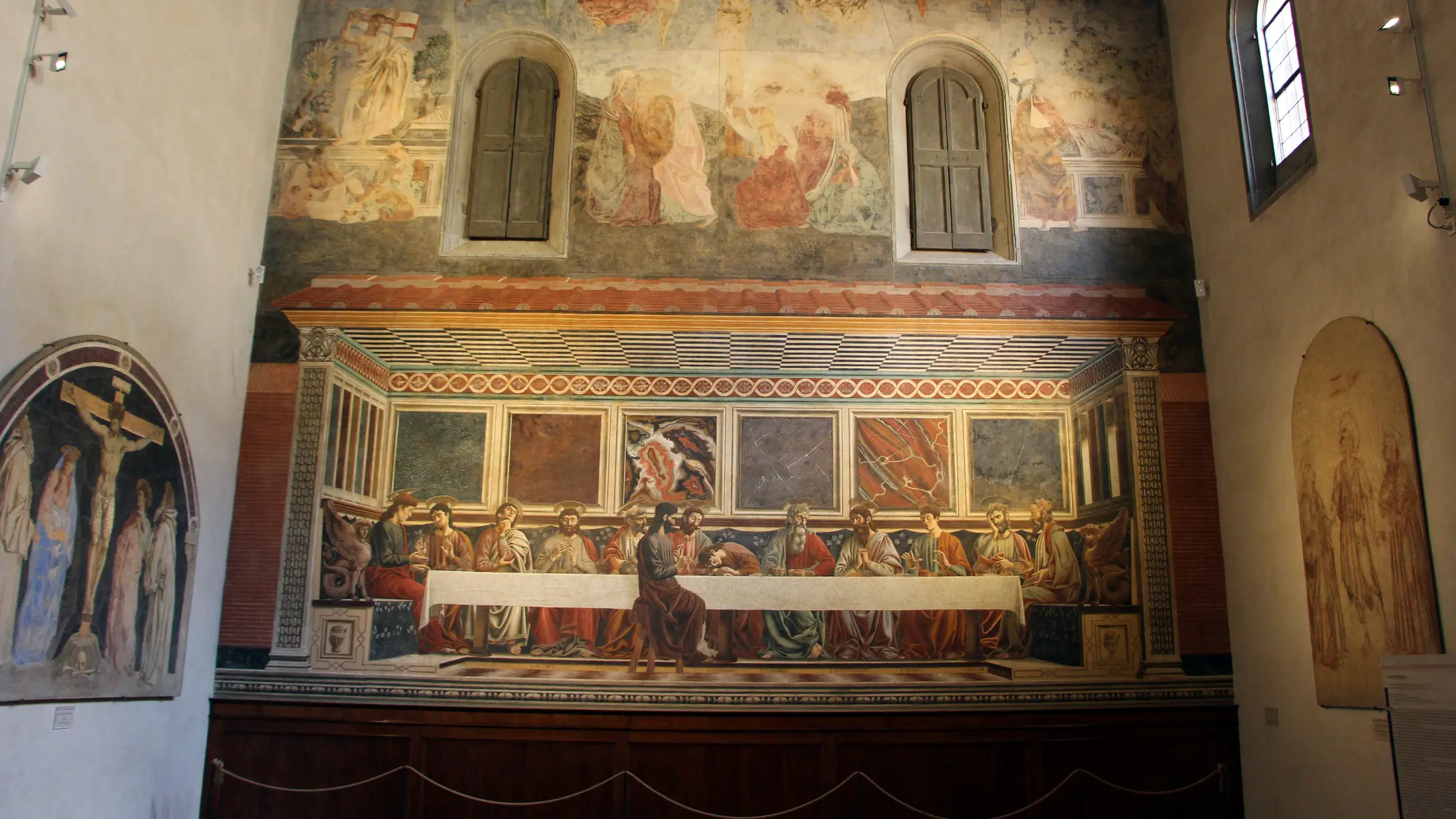
Cenacolo di Sant'Apollonia
The Refectory of Sant'Apollonia occupies part of the former monastery of the Benedictines of Saint Apollonia; open as a museum, it houses detached frescoes and sinopie by Andrea del Castagno and 15th-century works from the monastery.
On the end wall of the refectory is a fresco of the Last Supper by Andrea del Castagno and, above, a Resurrection, a Crucifixion and a Deposition dating to 1447.
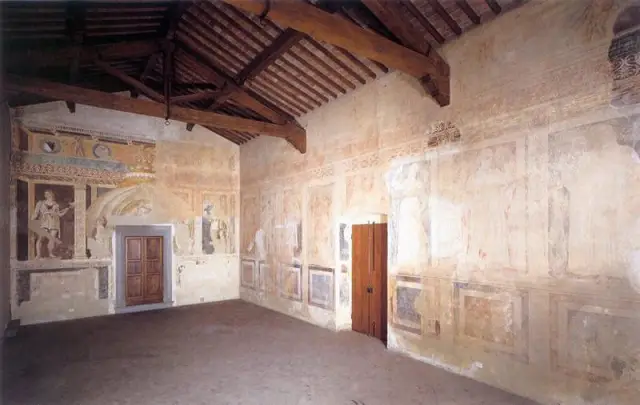
Villa Carducci Pandolfini
L'edificio deve la sua fama al ciclo di affreschi raffigurante "Uomini e donne illustri" che Andrea del Castagno eseguì intorno al 1455 sotto il loggiato, trasformato poi in salone. Le pitture, ritrovate sotto le scialbo che le occultava nel 1847, furono staccate e acquistate dal governo granducale. Esposte nel 1865 al Museo di Bargello, sono state successivamente trasferite al Museo di Andrea del Castagno in Sant'Apollonia, quindi, dopo l'alluvione, sistemate negli ambienti dell'antica chiesa di San Pier Scheraggio, al piano terreno della Galleria degli Uffizi, dove ancora si trovano.
Nel salone della villa, grazie alla ricostruzione del disegno d'insieme effettuata nel 1965 in base alle tracce rimaste al di sotto, è oggi possibile percepire la lettura dell'intero ciclo pittorico. I nove personaggi illustri sono raffigurati nel seguente ordine: Pippo Spano (condottiero fiorentino a servizio dell’imperatore Sigismondo contro i Turchi), Farinata degli Uberti (capo dei ghibellini e difensore di Firenze), Niccolò Acciaioli (fondatore della Certosa del Galluzzo), la Sibilla Cumana (assimilata ai profeti dell’Antico Testamento), la Regina Ester (che intervenne presso il re persiano Assuero in difesa del suo popolo minacciato di distruzione), la Regina Tomiri (a capo del popolo nomade dei Massageti vendicò la morte del figlio scatenando la battaglia in cui morì Ciro il Grande: questa figura risulta danneggiata all’apertura della porta), Dante Alighieri, Francesco Petrarca, Giovanni Boccaccio.
Cathedral of Santa Maria del Fiore
Florence Cathedral was designed at the end of the 13th century by Arnolfo di Cambio and is dedicated to Santa Maria del Fiore, a reference to the lily, the city's symbol.
The third largest cathedral of the world (after Saint Peter's in Rome and Saint Paul's in London), at the time of its consecretation in 1436 it was the largest in Europe. The building was erected on top of the earlier Cathedral of Santa Reparata, the remains of which are accessible via the nave.
The exterior, now clad in polychrome marble, remained incomplete for a long time; the original façade, which had been partially built to the design by Arnolfo di Cambio, was demolished at the end of the 16th century, and the current one was only erected at the end of the 19th century.
Inside, the nave and two side aisles end in a vast choir where the main altar stands, surrounded by the tribune on which the Cupola rests. On the left wall are frescoes depicting two condottieri, Sir John Hawkwood (otherwise known as Giovanni Acuto) by Paolo Uccello, who also did the fresco decoration on the clock on the interior façade, and Niccolò da Tolentino by Andrea del Castagno. The 44 stained-glass windows were the work of leading 15th-century masters, including Donatello, Andrea del Castagno and Paolo Uccello.

Uffizi Gallery
With its immense artistic legacy, the Uffizi Gallery, now The Uffizi, is one of the most important museums in the world. Following a substantial reorganization in the 17th century, which led to the transfer of some collections (arms, scientific instruments, archaeological finds, ancient and modern bronzes) to other sites and the establishment of new museums, the Uffizi mainly became a picture gallery, with thousands of works ranging from the 13th to the 18th centuries. After the suppression of churches and convents in the 18th and 19th centuries, many works of ecclesiastical provenance swelled the gallery’s collections; other important paintings were acquired at the beginning of the 20th century.
Masterpieces held in the museum include: the large altarpieces of Cimabue and Giotto; 14th-century Sienese art (including a fine Annunciation by Simone Martini); a rich spectrum of 15th-century art from Tuscany and central Italy, with works by Masaccio and Masolino (Madonna and Child with Saint Anne), Filippo Lippi, Botticelli (Birth of Venus and the Primavera), Piero della Francesca (Portraits of Duke Federico da Montefeltro and his Duchess Battista Sforza of Urbino) and Gentile da Fabriano (Adoration of the Magi).
The rooms devoted to 16th-century painting contain works by the masters of the principal Italian schools: from the Adoration of the Magi by Leonardo da Vinci to Michelangelo and Raphael, while Titian, with his Venus of Urbino, Veronese and Tintoretto represent the flowering of painting in the Veneto. Foreign artists are also well represented, with works by Albrecht Dürer, Hans Holbein and El Greco.
The series of 17th-century works opens with Caravaggio’s Bacchus, and features a rich range of work from the major European schools, including Rubens, Van Dyck and the self-portraits by Rembrandt. Finally, Canaletto and Guardi, together with Longhi and Tiepolo, offer a sample of 18th-century art. In addition, the gallery holds ancient sculptures, miniatures and tapestries from the Medici collections. Work is currently underway on the ‘New Uffizi’, which will double the amount of exhibition space, permitting the display of works previously inaccessible to the public.
A map of suggested paths in the gallery - including their duration - is available on the Uffizi Official Website.

Museum of Santa Maria Nuova
On June 23, 1288 Folco Portinari, the father of Beatrice, the woman who inspired the poetry of Dante, donated the land in Florence upon which the Santa Maria NuovaHospital was to be built. It is an example of the highest excellence in the Italian artistic, cultural and healthcare heritage. In fact, it is the oldest hospital in the world that is still in operation.
The complex consists of several cloisters, and contains an unsuspected chapel by Buontalenti and frescoed by Allori, one of the hospital's many treasures.
Santa Maria Nuova holds over 700 works of art, including important paintings, frescoes, sculptures and furnishings, and some of the greatest artists of all time have passed through its doors. One of them was Leonardo da Vinci.

Museo Virtuale Andrea Del Castagno
Devoted to the village’s most illustrious child, the painter Andrea del Castagno, the museum takes visitors on an imaginary journey through the 15th-century master’s artistic career by means of reproductions of the major works in Florence (where Andrea moved in 1440). Photographic panels illustrate the buildings and sites where his works are currently located.
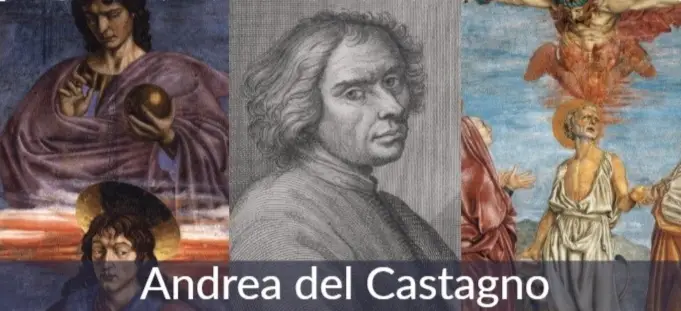
Santissima Annunziata Church
The basilica is the main Marian shrine in Florence. It was founded in 1250 by the "Seven Saints" of the order of the Servants of Mary; with its facade, contiguous to the Brunelleschi's facade of the Spedale degli Innocenti, it constitutes one of the sides of the scenographic, homonymous square.
The frescoed cycle of the Chiostrino dei Voti, before the entrance to the church, is an anthology of the early Florentine mannerism, with fine frescoes by Andrea del Sarto, Pontormo, Rosso Fiorentino.
he interior, mainly decorated in the Baroque era, contains numerous masterpieces, including the highly venerated fourteenth-century image of the Annunciation, inside the Renaissance temple designed by Michelozzo; according to legend, the painter—after awakening from a sudden sleep— found the face of the Virgin miraculously completed by angelic hands.